
.png)


Reconnecting With Nature: Why It Matters, How to Do It, and a Free Nature Scavenger Hunt

Most of us can feel it — the way a long stretch indoors leaves kids (and adults) wired, brittle, and oddly hungry for something a screen never satisfies. And most of us know the cure in our bones: get outside. But "reconnect with nature" can feel vague, like one more thing to do well. So let me make it concrete, the way we actually live it, and hand you a simple tool to start this week — a nature scavenger hunt you can take out the door today.
Reconnecting with nature means restoring a living, sensory, two-way relationship with the natural world — not just visiting it, but learning to perceive it, belong to it, and be regulated and taught by it. For a child, it's one of the most nourishing things on earth. For a depleted adult nervous system, it's medicine. And it doesn't require wilderness; it requires attention.

Why nature is the original curriculum
In our family, nature isn't an extracurricular. It's a primary teacher. It teaches patience, observation, interdependence, cycles, stewardship, presence, and humility — and it does something a classroom can't: it slows us down enough to notice what matters, and it settles a nervous system worn thin by stimulation.
Here's what that looks like for us. One morning's "school" is harvesting wild milky oats — the window is short, optimal only when the stalks are full of the white milk inside, so you have to know the plant and the timing, then boil it fifteen minutes for a creamy drink. Another day we go to Muir Beach and meet three plants: yarrow for boundaries, artemisia for dreaming, poison oak for practicing mindfulness of exactly where and how you step. We've watched the salmon spawn in Tahoe — facing the current, treading water, fasting, trusting — a whole teaching about when to swim upstream. That was school. That was enough.
None of that needed a worksheet. The natural world is endlessly, freely instructive the moment a child is invited to actually meet it.
Reconnecting in an age of screens
I want to be precise here, because I'm not anti-technology. I'm genuinely pro-AI — I think learning to use it well is crucial, and I love it for compression: learning a language or drilling a skill faster, so it takes less time. But that's exactly the point. The reclaimed time is meant to go somewhere — and the somewhere is here: nature, hands, movement, real making.
So the governing rule in our home is simple: learn through the screen efficiently, then close the laptop and go outside. Screens are for creation and compression, never for passive consumption or scrolling. Reconnecting with nature isn't a nostalgic rejection of the modern world; it's the deliberate other half of a life with screens in it. The technology earns its keep by giving childhood back to the body and the world.
How to actually start (it's smaller than you think)
You don't need a national park or a free weekend. Reconnection is built from small, repeatable contact:
Go often, not far. A backyard, a city park, a single tree you visit through the seasons. Frequency beats grandeur. The same patch of ground, watched over months, teaches more than a once-a-year spectacular view.
Lead with the senses, not the facts. Before naming anything, notice it. What do you hear? What's the texture? What's moving? Slowing into sensation is the doorway — facts can come later, if they come at all.
Meet specific living things. Pick one plant, one bird, one insect, and actually get to know it over time. A relationship with a single yarrow plant does more than a list of fifty species names.
Let them get bored and dirty. Unstructured, unsupervised-ish time in nature is where kids generate their own play, questions, and discoveries. Resist the urge to turn every outing into a lesson.
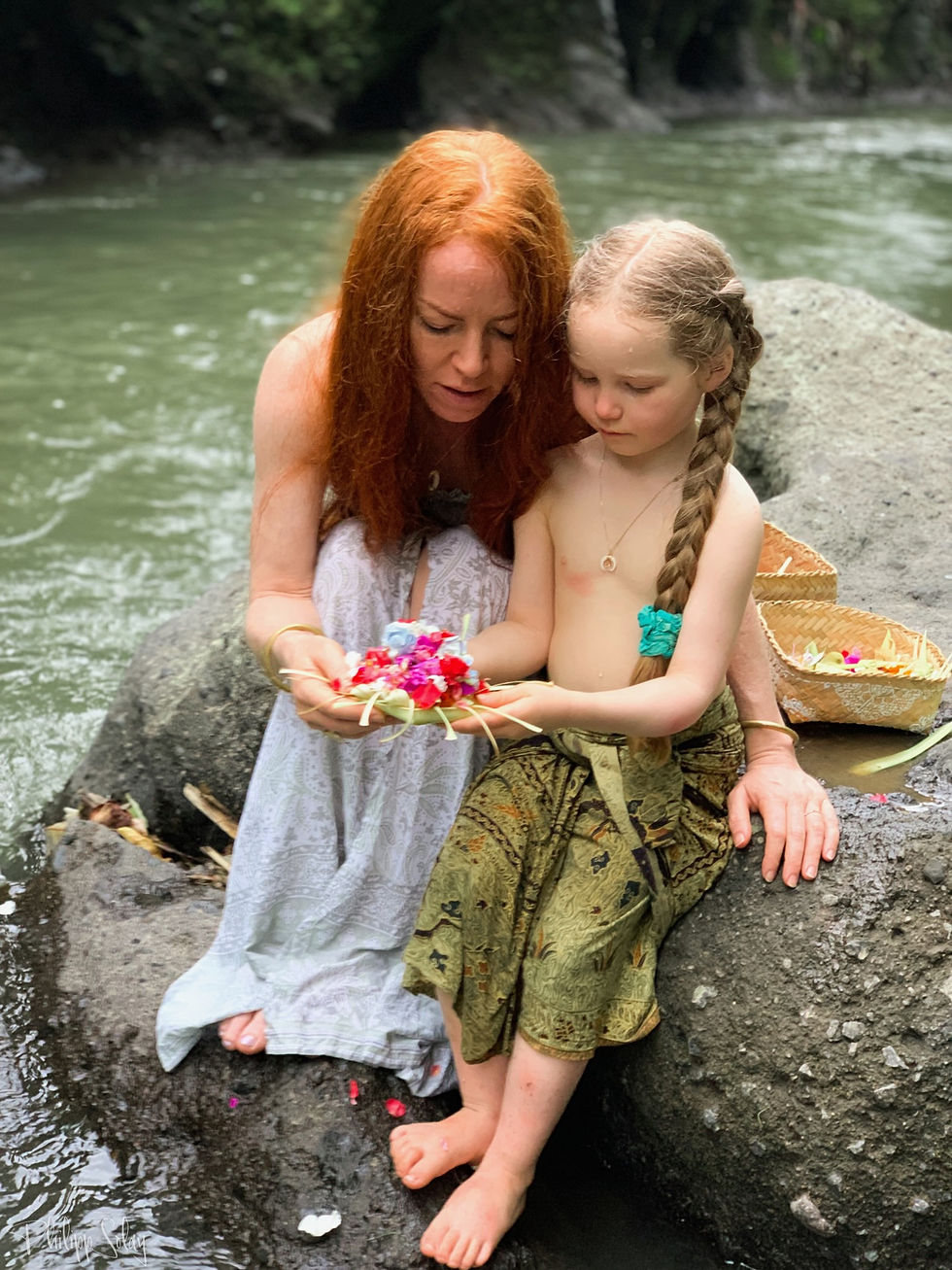
Bring reverence. Greet the place. Leave it better. A small offering, a thank-you, a moment of noticing — this is how a child learns that the living world is a someone, not a something.
Your free Nature Scavenger Hunt
Here's the easiest possible on-ramp — a scavenger hunt turns "go reconnect with nature" into a game a child will actually run with. Take it to a backyard, a trail, a beach, a park. The goal isn't to win; it's to notice.
🌿 Find & Notice (don't pick living things unless they're abundant and you have permission):
Something older than you
Three different textures (rough, soft, smooth)
A seed on its way to becoming a plant
Something that's decomposing (and feeding new life)
A creature smaller than your fingernail
Evidence an animal was here (a track, a feather, a chewed leaf)
Two plants you don't know the names of
Something that smells like the season
👂 Stop & Sense:
Close your eyes and count five different sounds
Find the stillest spot you can and sit in it for one minute
Notice the temperature change between sun and shade
Feel the ground through your hands or feet
🙏 Honor:
Choose one living thing to greet and thank
Leave the place a little better than you found it
Tell someone one thing you noticed that you'd never seen before
Print it, screenshot it, or just read it aloud at the door. The magic isn't the list — it's that it gets you outside, and gives a child a reason to look.
(Want it as a beautiful printable? I'm putting together a free Nature Scavenger Hunt + "Days in Nature" tracker to keep on the fridge — they'll go out to the email list first. Grab them below.)
Frequently asked questions
Why is reconnecting with nature important for kids?
Nature regulates the nervous system, restores attention worn down by screens and stimulation, and teaches capacities a classroom can't — patience, observation, interdependence, stewardship, presence. It also supports physical health and emotional resilience. For children, regular, sensory contact with the natural world is deeply nourishing rather than optional.
How do I help my child reconnect with nature?
Go often rather than far (a backyard or local park works), lead with the senses before facts, help them get to know one specific plant or creature over time, allow unstructured and even boring outdoor time, and model reverence — greeting and caring for the place. Small, repeated contact builds the relationship more than occasional big trips.
What is a nature scavenger hunt?
A nature scavenger hunt is a simple outdoor game where children look for specific natural items or experiences — something older than them, a particular texture, an animal sign, five different sounds. It turns "go outside" into an engaging, low-prep activity that trains children to notice and connect with the natural world.
What should you put on a nature scavenger hunt?
A good list mixes finding ("something decomposing," "a seed," "an animal sign"), sensing ("count five sounds," "feel the temperature change"), and honoring ("greet one living thing," "leave the place better"). Keep items open-ended so they work in any season or landscape, and emphasize noticing over collecting.
Do screens and nature have to be in conflict?
Not if screens are used for compression and creation rather than passive consumption. The approach that works in our family is to use technology (including AI) to learn efficiently — then close the laptop and go outside. Used that way, screens actually free up more time for nature, not less.
The free Nature Scavenger Hunt + "Days in Nature" tracker go to the email list first — come grab them, and get the once-every-moon letters → sacredschooling.com. (Related: What Is Unschooling? · Worldschooling)
— Bronwyn Ayla, L.Ac.
Comments