
.png)


What Bali Taught My Daughter (and Me) About Worldschooling

Updated: Aug 5
Nymue and I went to Bali for the month of May.
It was our second time on the island together. We did not bring a syllabus. We brought attention.
This is what the world taught us when we let it.
The volcano
We visited a volcano.
Nymue touched cooled lava. She gathered lava rocks. She had been in a sweat lodge the week before we left, so the rocks were not abstract to her. They were sacred — heated relatives, born of the earth's fire, finally cooled into something you could hold.
That opened into a real conversation about the volcanic eruption happening in Hawaii at the same time. Geology. Geography. Reverence for the body of the earth. All of it arriving on its own.
No one had to teach her that the rocks were alive. The rocks were alive. She felt it.
Banana leaf offerings
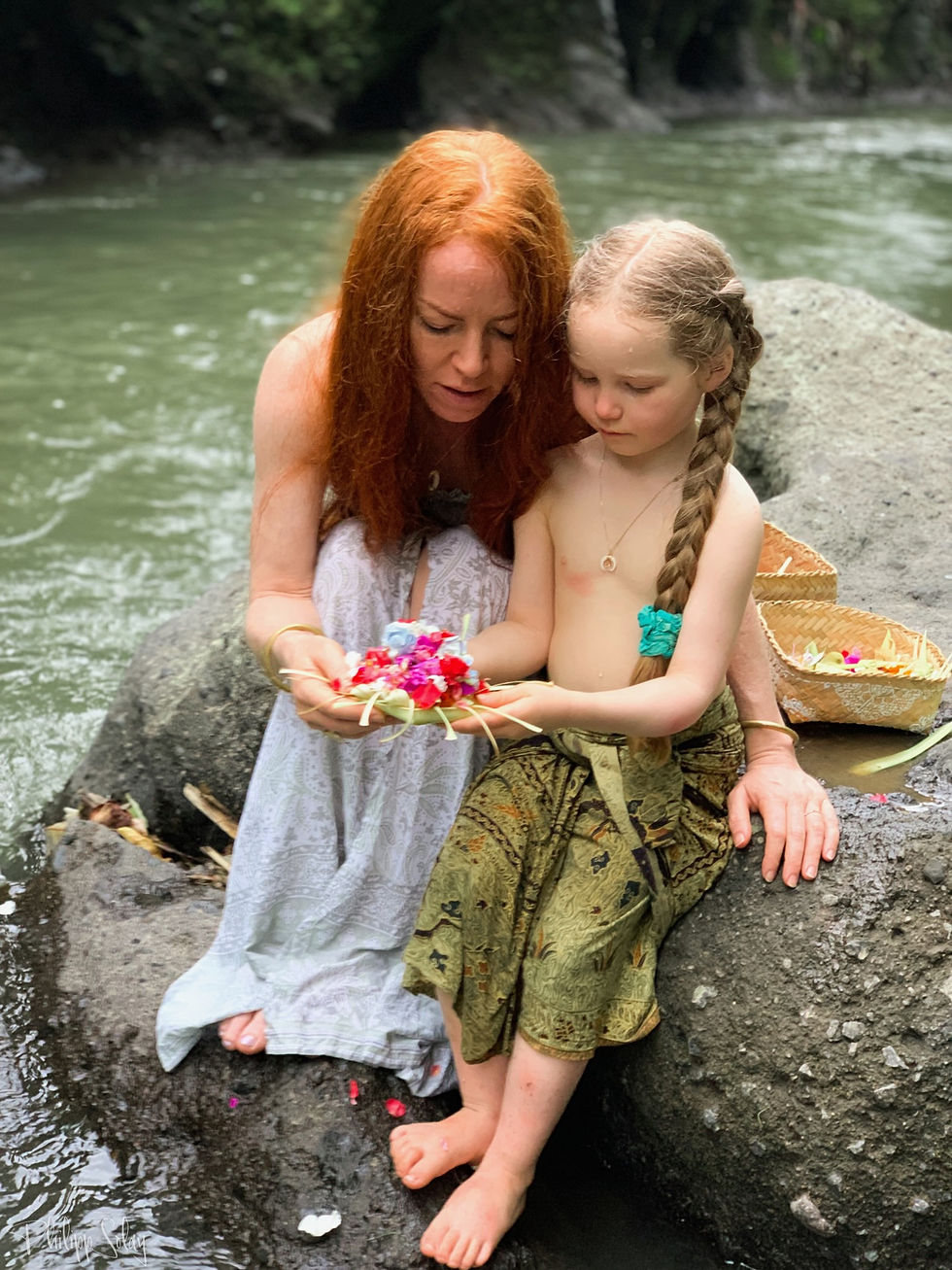
She apprenticed with women who make daily offerings from banana leaves.
These are small, precise, ephemeral artworks. The women fold the leaves into tiny baskets, fill them with flowers and rice and a stick of incense, and place them on altars, thresholds, the dashboards of cars, the corners of shops.
They are not decoration. They are how Balinese people stay in continuous conversation with the divine. A moment to align with prayer. A moment to thank the unseen.
Nobody graded Nymue's offering. Nobody corrected her folds. The women's hands guided hers, and then she made her own, and then she placed it. It was real prayer, with real care, in a real lineage that had been doing this for centuries.
You cannot put that on a scope-and-sequence.
The rice field outside our villa
Outside our villa, the rice field moved through its harvest cycle.
We watched rice become food, not as a diagram or a unit study, but because it was happening twenty feet away. The green stalks turned gold. Women in conical hats came with curved knives. The grain was beaten, dried, winnowed, bagged.
There were ducks outside the villa. Nymue observed them every day and ate their eggs. There were monkeys to watch and monkeys to fend off when they tried to steal our things. Tiny baby chickens darted across the road while I drove her on the scooter.
This was geography, agriculture, animal behavior, and food systems — taught by the land itself.
Dance as belonging
Nymue took Balinese dance classes.
But some of the deepest learning happened informally. In the evenings, we would stop where local women were practicing in temple courtyards. They would scoop Nymue up, wrap her in a sarong, and guide her hands through the movements.
She did not need to speak Balinese. The hands were teaching. The bodies were teaching. The grandmothers were teaching.
This is what age-diverse, embodied, cross-cultural learning looks like. It is not a unit on world cultures. It is being held by other cultures and learning what your body can become inside them.
Philius and the hornbill feather
The story I keep returning to is Philius.
We went to an Indigenous celebration where Nymue met Philius, an elder Dayak man from Kalimantan, Borneo.
She turned to me and said, "Mamma, that man is magic. I can feel his magic all over my body, but especially in my heart."
Later that evening, we got to speak with him. When I told him what she had said, he took off his headdress, plucked a hornbill tail feather from it, and handed it to her as a medicine gift.
You cannot put that on a worksheet. But it taught her something I would want any child to learn: perception, reverence, generosity, being met, and the reality that the world is more alive than we have been trained to admit.
She still has the feather. It still carries the moment.
What Bali was for
If I had taught Nymue these subjects through a curriculum, she would have studied volcanoes, world religions, agriculture, Indigenous cultures, Asian dance, and ecology.
Instead, she lived inside them for a month.
She did not learn about Balinese culture. She was, briefly, held by it. She did not learn about volcanoes. She held a cooled volcano in her hands. She did not learn about Indigenous wisdom traditions. She received a feather from an elder who saw her.
That is the difference.
You do not need Bali to worldschool. You need the posture. The world is teaching everywhere. Your child is allowed to meet it. The question is whether you can stop treating the real world as enrichment and start treating it as primary.
Nymue offers one-on-one mentorship for children whose families travel and learn this way.
If you are ready to learn this way of seeing alongside your child and other families practicing the same, our retreats are where this becomes real.

Comments