


Full Moon Ritual: A Simple, Real Practice for Modern Families

A full moon ritual is a simple, intentional practice of marking the moon's peak each month: pausing to release what's complete, name what's true, and reconnect with a rhythm older than any calendar. It doesn't require crystals, a kit, or anyone else's permission. It requires a sky, a few minutes, and your attention. Here's a grounded guide to a full moon ritual worth keeping, alone or with your family.
The moon has been a talisman my whole life, the thing that's there no matter where in the world I find myself. When my daughter and I chose our shared last name, Ayla, one of its meanings sealed it: halo of light around the moon. So this isn't a trend piece for me. Moon rhythm is how our family keeps time.

Why the full moon
The moon's cycle is the original month. For most of human history, people planted, harvested, gathered, rested, and celebrated by it. The full moon was the bright night, the gathering night, the seeing-clearly night. In most traditions it carries the same essential meaning: culmination. What was seeded earlier in the cycle is now visible, lit up, complete or ready to be released.
You don't have to believe anything mystical for this to work on you. A monthly pause, same sky, same questions, same honesty, is a powerful practice on purely human terms. The moon just makes it beautiful, visible, and impossible to forget.
A simple full moon ritual (the whole practice)
Go outside. This matters more than anything else on the list. Stand where you can see the moon, or at least the sky. Bare feet on the ground if it's warm enough. Let your body arrive before your mind does anything.
Light something. A candle, a small fire if you have the place for it. Fire marks the moment as different from ordinary time. That's all ceremony is: a boundary around attention.
Name what's complete. Out loud or on paper: what has come to fullness this month? What worked? What arrived? Gratitude first, it opens the rest.
Name what you're releasing. The full moon is the classic time for letting go, a habit, a resentment, a story about yourself, something you've been gripping. Write it down and burn it in the candle flame (safely, in a bowl), or simply say it out loud to the sky. The physical act matters; the body believes what it does.
Sit for a few minutes. No phone. Just the sky, the quiet, the breath. This is the medicine. Everything else is scaffolding for these minutes.
Close simply. A word of thanks, blow out the candle, done. Ten minutes total, if that's what you have. The power is in the repetition across months, not the production value of any single night.
Doing it with children
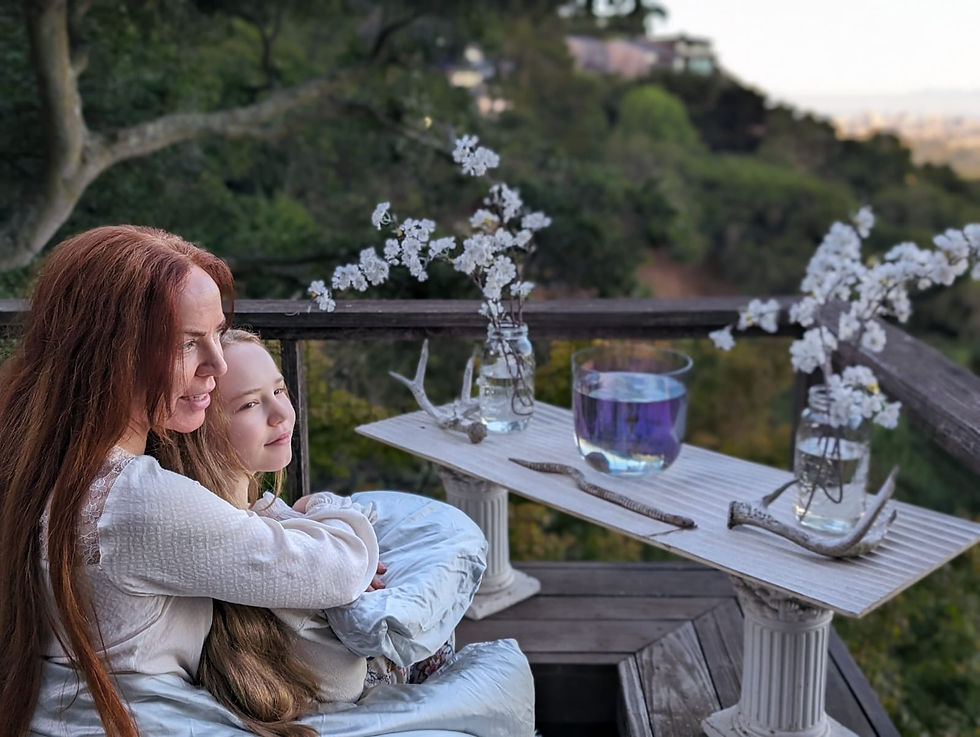
A full moon ritual might be the easiest ceremony to share with kids, because the moon does most of the work. Children are natural moon-watchers. In our home this rhythm is woven into everything, it's part of how we school, how we gather, how we mark time.
With kids, keep it even simpler: go out together, find the moon, let everyone name one thing they're proud of from the month and one thing they're ready to let go of. Maybe a howl, if the mood strikes, laughter belongs in ceremony. A child who grows up marking the full moon inherits something rare: the felt sense that time is rhythmic, that life has seasons, and that pausing to tell the truth is normal.
What to release (and what to keep)
Release: the idea that you need supplies, that you have to do it "right," that missing a month breaks anything, that it has to look like anyone else's practice.
Keep: the going outside, the honesty, the repetition. A full moon ritual kept simply for a year will change your relationship with time. That's not mystical, or rather, it is, and it's also just true.
Frequently asked questions
What is a full moon ritual? A full moon ritual is an intentional practice of marking the moon's monthly peak, typically by pausing to express gratitude for what's come to fullness, releasing what's complete or no longer serving you, and spending quiet time under the sky. It can be as simple as ten minutes with a candle and a journal.
What do you do during a full moon ritual? A simple structure: go outside, light a candle, name what's complete this month, name and release what you're letting go of (many people write it and safely burn the paper), sit quietly for a few minutes, and close with thanks. Repetition month over month matters more than elaborateness.
What should you release on a full moon? Whatever is genuinely complete or costing you: a habit, a resentment, a story about yourself, a commitment that's expired, a fear you've outgrown. The full moon traditionally marks culmination, the natural moment to let go of what has finished its work in you.
Can you do a full moon ritual with kids? Yes, it's one of the easiest ceremonies to share with children. Go out together, find the moon, let each person name something they're proud of and something they're releasing. Kids take to moon rhythm naturally, and growing up with it gives them a felt sense of seasonal time.
Do you need special supplies for a full moon ritual? No. A candle and something to write on are plenty, and even those are optional. The essential ingredients are going outside, honesty, and repetition. Everything else is preference.
What if it's cloudy or I miss the exact full moon night? It still counts. The moon is full to the eye for about three nights, and the practice works within a day or two on either side. Clouds don't cancel the moon, or the pause.
Sanctuary gathers weekly around exactly this rhythm: moon-based ceremony, seasonal practice, and other families keeping it alive alongside you.
If you want to live by the moons and seasons, I made a free calendar for it: the Sacred Almanac.
Bronwyn Ayla, L.Ac.


Comments